03/Selected Work

Research portfolio.

Here are the things I've built, and together they tell the story of how my research has evolved.

3.1 / Building Physical Models

How can we build physical systems that reproduce relevant biomechanical behaviour?

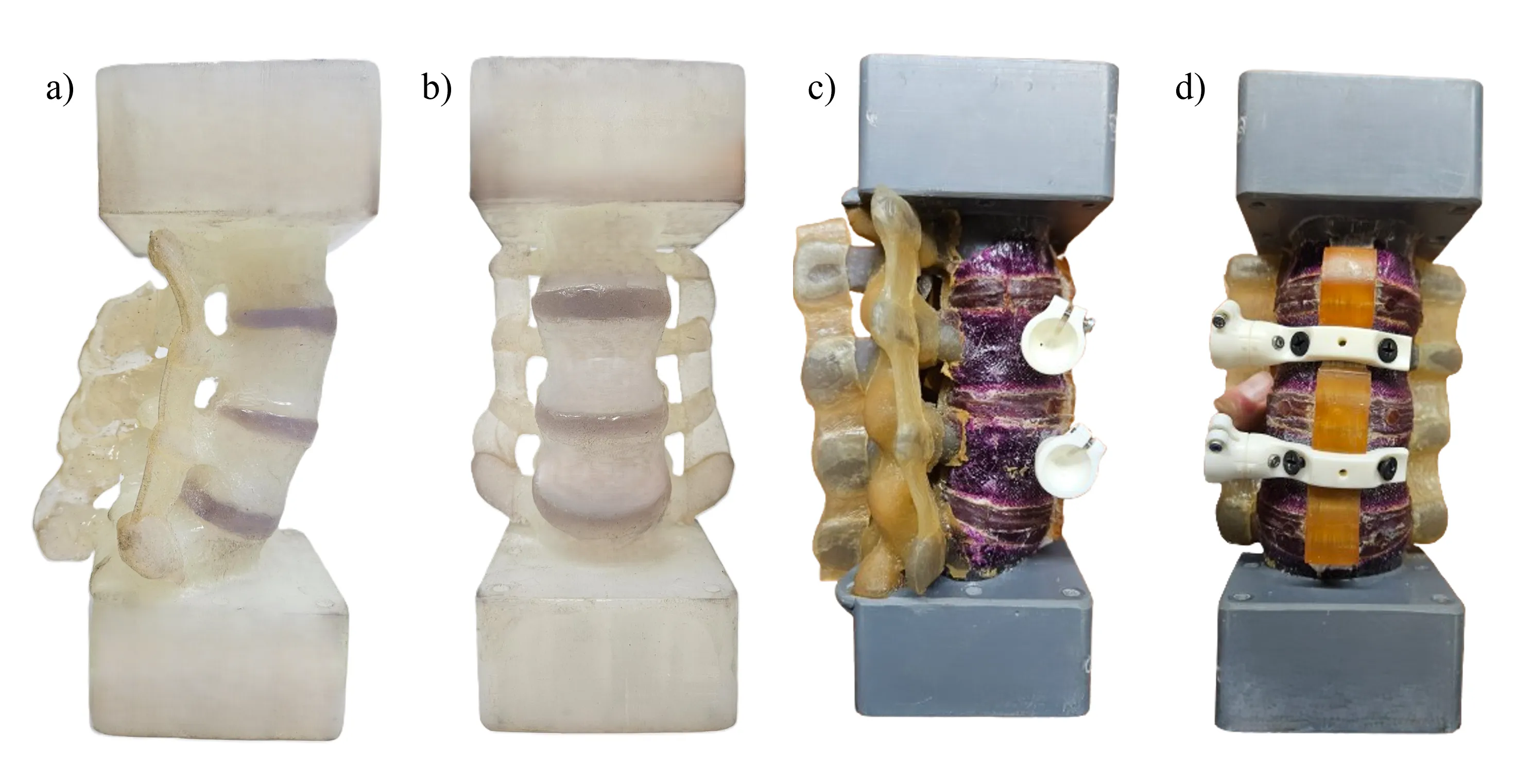
Research figure: 3D-Printed Analogue Spine Models

3D-Printed Analogue Spine Models

Cadaveric specimens are the gold standard for spine biomechanics, but they are costly, ethically constrained, and biologically variable. This project developed fully 3D-printable analogue models of the lumbar spine (L1–S1 and motion segments), manufactured on consumer-grade FDM and resin printers: rigid printed vertebrae, flexible TPU intervertebral discs, and printed ligamentous structures including the thoracolumbar fascia. The models were validated under displacement-controlled pure moment loading against ex vivo and finite element reference data, then used as an experimental platform for systematic ligament construction–deconstruction studies quantifying how individual ligaments — and their failure — shape spinal stiffness.
3.2 / Building Computational Models

How can we represent the mechanics of the human body computationally?

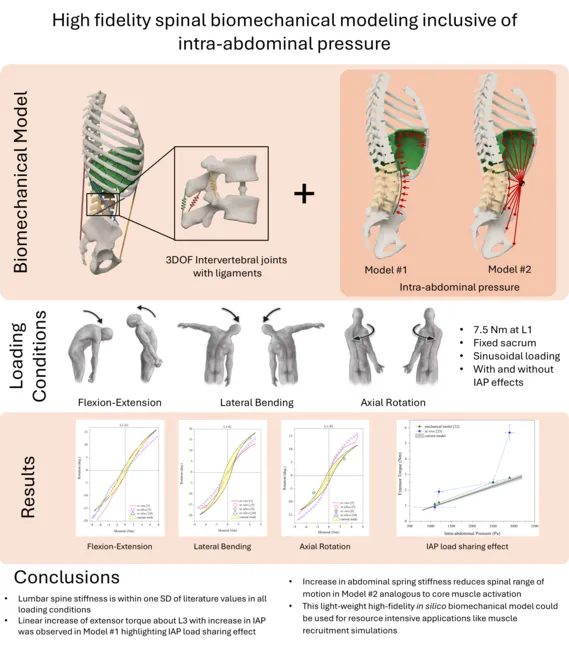
Research figure: Fast-Solving Rigid Body Spine Model with Intra-Abdominal Pressure

Fast-Solving Rigid Body Spine Model with Intra-Abdominal Pressure

Musculoskeletal spine models either neglect intra-abdominal pressure (IAP) or are too computationally expensive for iterative optimization. This project developed a fast-solving rigid-body dynamics model of the lumbar spine — pelvis to ribcage, geometry adapted from MRI scans — with nonlinear disc joints, tension-only ligaments, and two alternative IAP formulations. Segmental stiffness profiles were validated against in vivo literature, and the model's seconds-fast runtime opens the door to muscle recruitment optimization and machine learning applications.

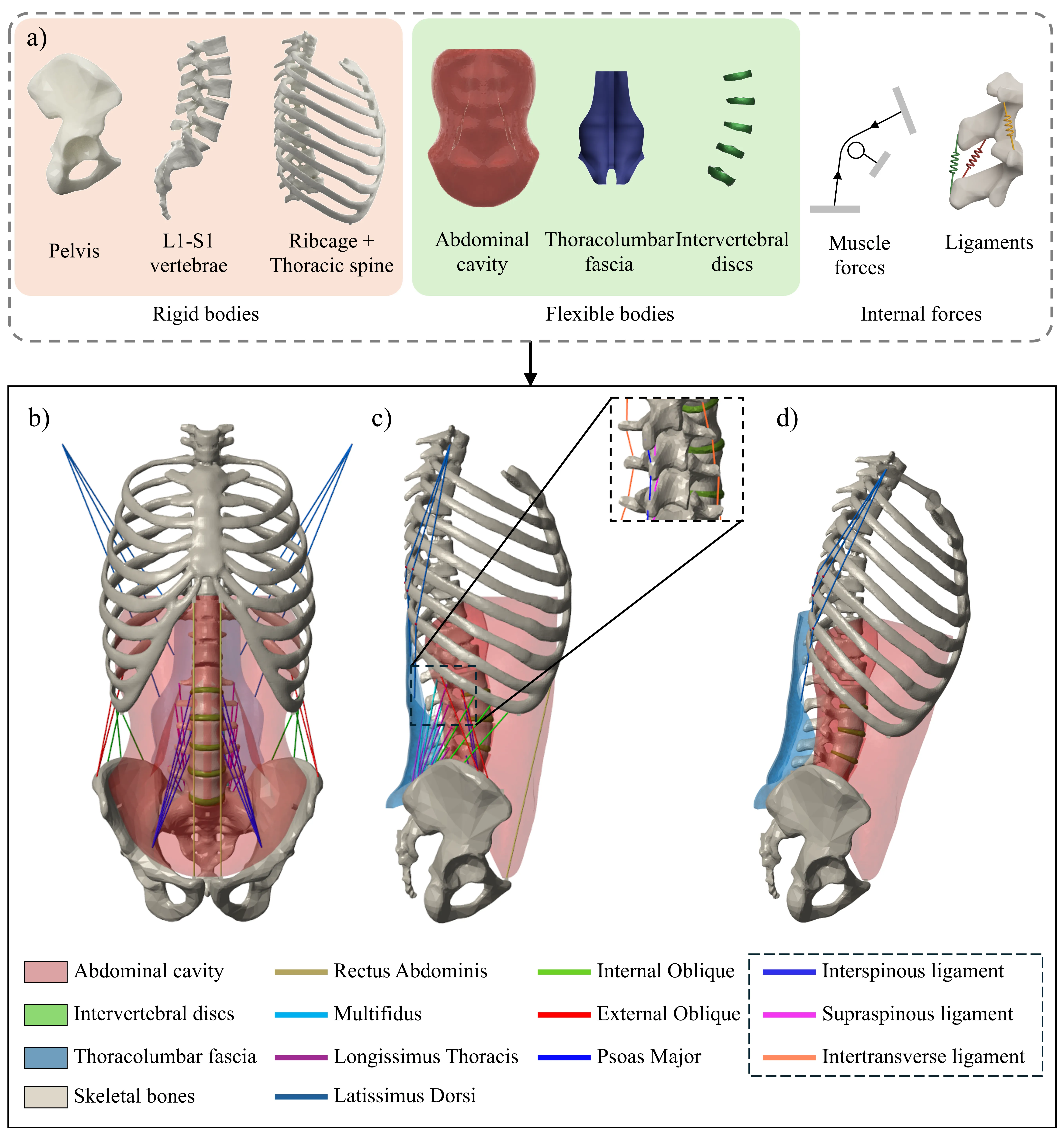
Research figure: Rigid-Flexible Body Musculoskeletal Model of the Spine and Torso

Rigid-Flexible Body Musculoskeletal Model of the Spine and Torso

Rigid-body models are fast but omit tissue compliance; finite element models capture it at prohibitive cost. This project developed a rigid-flexible body dynamics (RFBD) formulation that embeds flexible elements within an efficient multibody spine-and-torso model, aimed at muscle recruitment optimization problems. Validated for fast-solving simulation, the model extends the rigid-body work toward higher-fidelity load sharing across the torso — conceived as a parametric biomechanical digital twin.

3.3 / Testing & Validating Models

How do we determine whether these models actually represent reality?

Research figure: Inter-Laboratory Standardization of Spine Testing

Inter-Laboratory Standardization of Spine Testing

Before engineered surrogates can complement cadaveric testing, the field needs to know how consistently laboratories measure the same object. Within the International Spine Biomechanics Consortium — a working group of seven spine biomechanics laboratories — this project ran round-robin testing of composite lumbar spine surrogates across institutions in North America and Australia. The results showed inter-laboratory variability exceeding temporal variability within a single lab, identified sources of divergence in fixtures and protocol interpretation, and motivated harmonized testing practices.

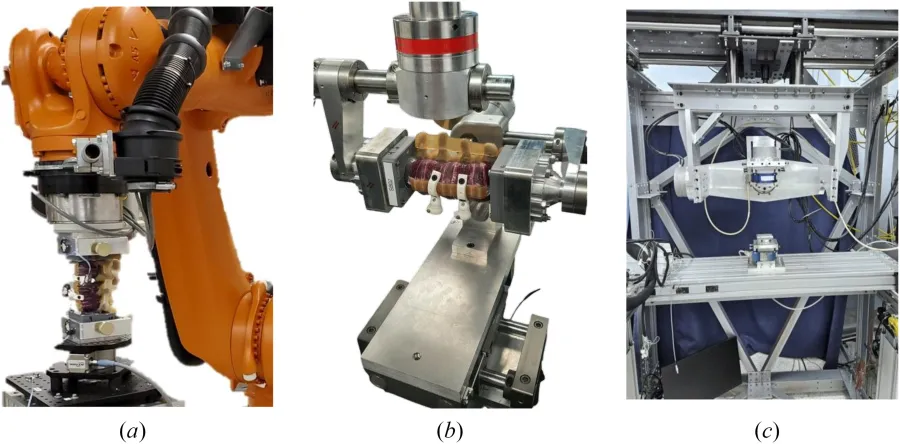
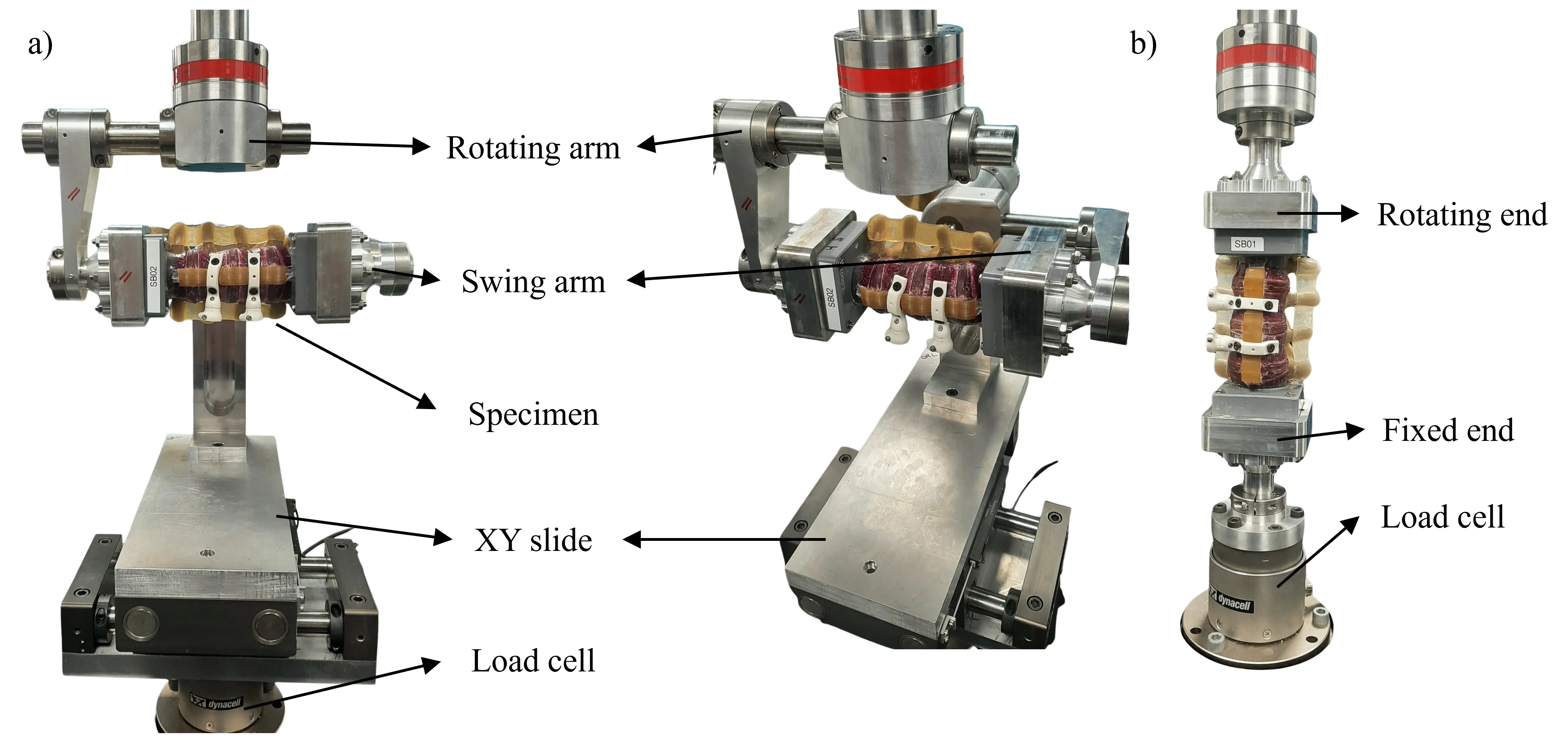
Research figure: Robotic Benchtop Spine Testing Platform

Robotic Benchtop Spine Testing Platform

Conventional spine testing depends heavily on operator skill and specimen variability. This project contributed to a robotic benchtop platform that applies standardized pure-moment loading protocols (±7.5 Nm across flexion–extension, lateral bending, and axial rotation) with sub-degree repeatability. Starting with implementation and validation of the platform's control system, the work grew into using the robot as the primary validation instrument for every analogue model developed in the lab, and later for multi-specimen collaborative testing with partner institutions.

3.4 / Bringing Models Together

How can physical and computational models inform one another?

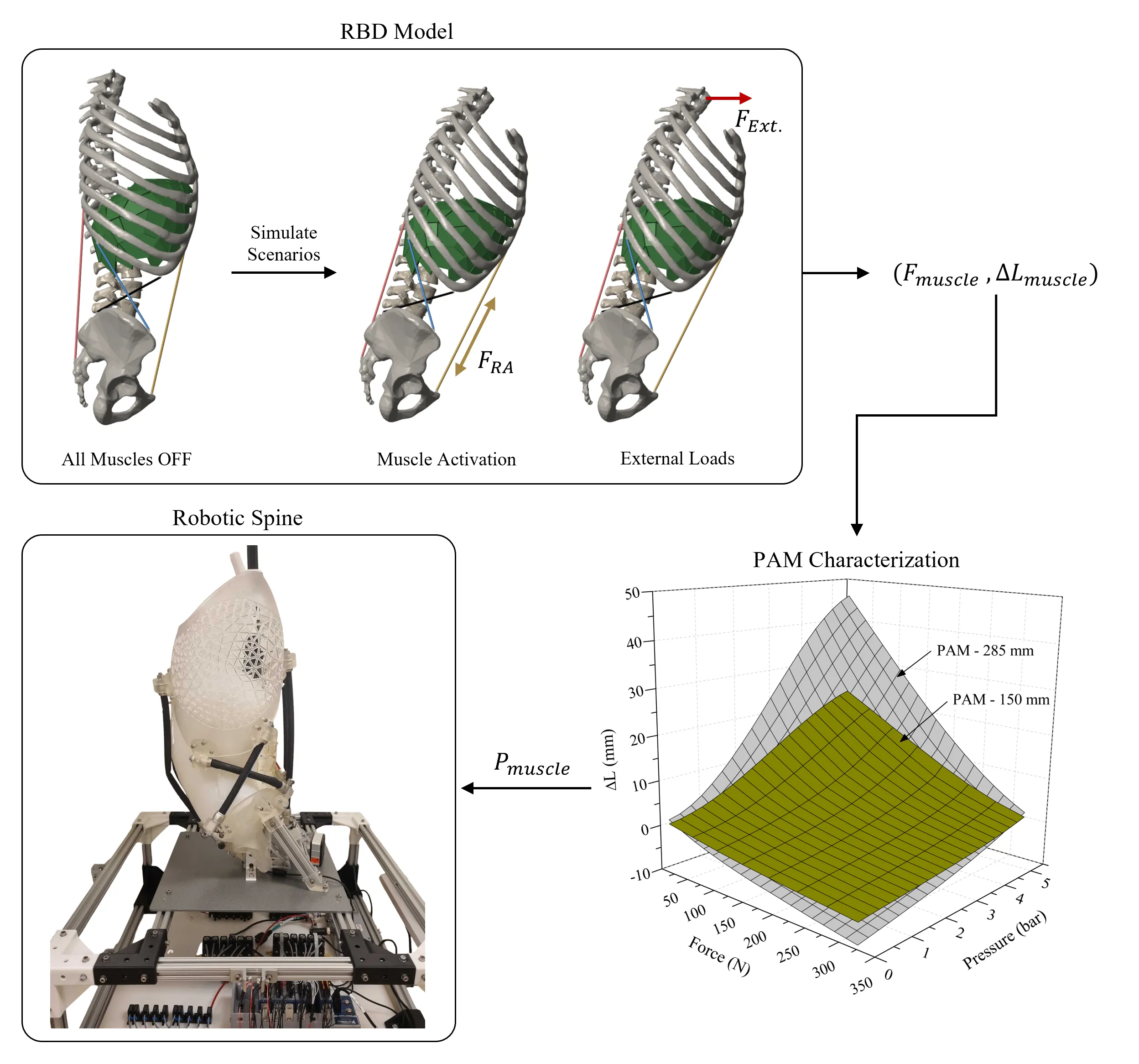
Research figure: Toward a Robotic Spine Simulator

Toward a Robotic Spine Simulator

Physical models, computational models, and experiments are most useful when they inform one another. This thread of the doctoral research brought the 3D-printed surrogates, the robotic testing platform, and the rigid-body and rigid-flexible models into a single workflow: models were fabricated, loaded on the robot, compared against computational predictions, refined, and re-tested. That same loop — build, test, simulate, validate — is what model credibility frameworks such as ASME V&V 40 formalize, and it is the bridge from academic spine biomechanics to patient-specific medical simulation. Translational extensions include custom spine phantoms for surgical training through a McGill lab spin-off, and validation data for a patient-specific spine digital twin with clinical partners.